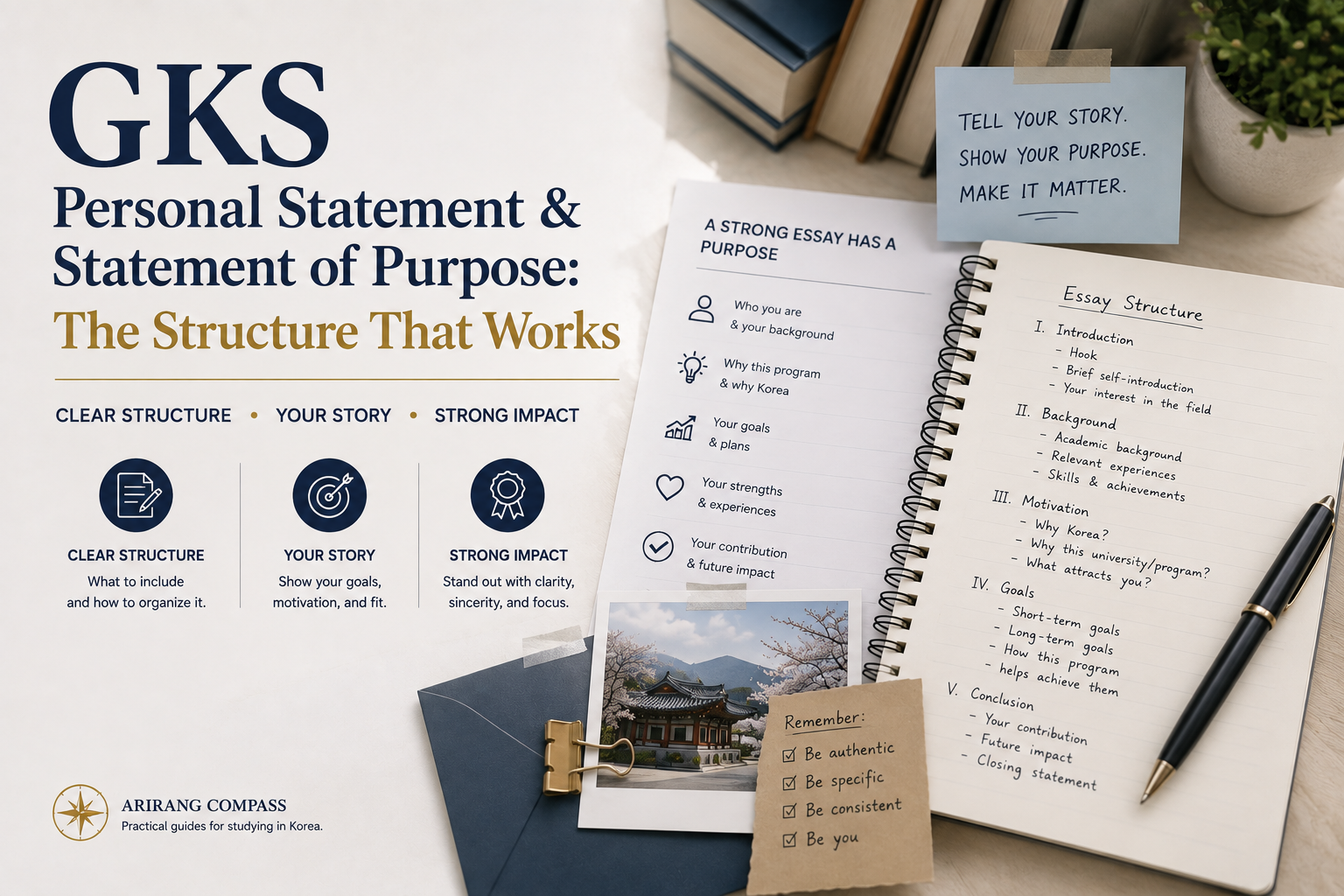
By the time GKS narrows its pool, almost everyone left has cleared the eligibility floor — the GPA, the language basics, the paperwork. What separates a scholar from a rejection at that point is rarely another line on the CV. It comes down to two documents most applicants underestimate — and, revealingly, mislabel.
Here is what the sample-essay blogs blur: GKS asks for two separate forms, and they are not both “personal statements.” Form 2 is the Personal Statement. Form 3 is the Statement of Purpose — and Form 3 carries three labeled sub-prompts of its own that most applicants answer as if they were one question. Collapsing the two forms into a single essay, and collapsing Form 3’s three prompts into one, are the two most common ways qualified applicants fail. This guide is about the division of labor the forms are actually asking for.
One caveat first, in the spirit of the GKS guide: form numbers, exact prompt wording, and length limits shift between cycles, and the current Application Guidelines PDF on studyinkorea.go.kr is the only version that binds you. Everything below is about structure and strategy, which stay constant. Check the current forms for the specifics.
The Two Forms, and What Each One Is For
The fastest way to write both badly is to think of them as “the essay” and “the other essay.” They have distinct jobs, and the reviewer reads them as a pair:
Form 2 — Personal Statement
Form 3 — Statement of Purpose
Tense
Mostly past and present
Almost entirely future
Answers
Who are you, and why does this path make sense given where you’ve been?
What exactly will you do — before, during, and after — and where does it lead?
Core content
Background, motivation, the story that led here, why Korea specifically
Language plan, goal of study + detailed plan, future plan after study
Failure mode
Generic “I have always loved Korea”
Vague “I will study hard and grow”
Read that table twice. The Personal Statement is your past explaining your present; the Statement of Purpose is your present committing to a future. When applicants repeat themselves across the two — the same motivation paragraph, the same career line — it is because they never internalized this split. Reviewers notice immediately, and it reads as either padding or confusion. Neither wins a fully funded scholarship.
Form 2 — The Personal Statement: Structure That Works
The Personal Statement is not an autobiography, even though the prompt invites your life story. It is a targeted argument that you and this program are a coherent match. A structure that consistently works:
Open with the specific, not the sweeping. Skip “Since childhood, Korea has fascinated me” — and skip the famous-person epigraph while you’re at it. Open on the concrete moment, problem, or question that actually points at what you want to study. Reviewers read hundreds of these; the grand opener is the one they can finish for you.
Build the through-line. Your academic and personal history should read as a path toward this program, not a résumé in prose. Every experience you include should answer “and that is why this field, in Korea, now.” Cut anything that doesn’t.
Make Korea specific. “I want to experience Korean culture” is not a reason; it’s a gap where a reason should be. Why Korea for this field — a research strength, a particular scholar or lab, an industry, a methodological tradition, a policy context? Specificity here is the difference between a tourist and an applicant.
Close on trajectory, briefly. A short bridge toward what you want to become sets up the Statement of Purpose without stealing its job.
Keep it disciplined — GKS gives you roughly a page, and reviewers reward candidates who can be specific within a limit. Sprawl reads as a thinking problem, not a space problem.
Form 3 — The Statement of Purpose: Three Prompts, Three Jobs
This is where applications are won, and it is not one question. GKS breaks Form 3 into three labeled sections, and each wants something genuinely different. The trap is pouring everything into the middle one and treating the other two as afterthoughts — all three are scored.
1. Language Study Plan. The official prompt asks for your plans to improve the foreign languages — Korean, English, and others — required for your degree, before and after you come to Korea. Three things applicants miss here. First, it says before: mention what you’re doing now, not just what you’ll do on arrival. Second, it isn’t only about Korean — if your program needs English or another research language, address it. Third, this is where the funded language-training year belongs: give a current level, a target TOPIK level, and concrete plans for the year. Nearly every scholar does a year of full-time Korean before the degree, with a real TOPIK threshold to clear before advancing — showing you know this is coming signals you read the program honestly.
2. Goal of Study & Study Plan. The prompt asks for your goal of study and a detailed plan — this is the research core. You don’t need a finished thesis, but you must think like someone who will write one: a clear question, why it matters, roughly how you’d approach it, and how it connects to the specific department you’re applying to. Naming faculty whose work genuinely overlaps yours is powerful, and it’s the natural payoff of having contacted a professor before applying . For graduate applicants, this section is close kin to the full research proposal (연구계획서) your department will later demand — treat it as the first draft of your academic identity.
3. Future Plan after Study. The prompt asks for your plan — in Korea or another country — after the degree. This is where post-scholarship contribution lives. GKS is an instrument of Korean soft power and development cooperation, and this section is where you acknowledge that without pandering. What will you do with the degree, and how does it create value — for your home country, for Korea-related work, for the field? Vague gratitude fails; a specific, plausible plan — even a modest one — is what “future plan” means here.
A useful frame: the Personal Statement earns their attention; the Statement of Purpose earns their money. Budget your effort accordingly.
The Failures That Sink Strong Applicants
Sorted roughly by how often they appear:
Collapsing the two forms. The number-one failure. If your Personal Statement and Statement of Purpose share paragraphs, you’ve written one document twice and wasted half your allotted space.
Answering Form 3 as one question. Pouring everything into “goal of study” and leaving the language plan and future plan thin. All three prompts are scored; treat them that way.
Generic affection for Korea. K-content, kimchi, and “the beautiful culture” are not motivations. They are what everyone writes. If your reasons would survive find-and-replacing “Korea” with another country, they aren’t reasons yet.
A study plan with no plan. “I will work hard, attend all classes, and become an expert” says nothing. Specifics — a research question, a TOPIK target, a timeline — are the entire point.
Ignoring the “before” and “other languages” in the language prompt. The prompt is broader than “I’ll study Korean when I arrive.” Answer all of what it asks.
Over-length and sprawl. Blowing past the limit doesn’t read as enthusiasm; it reads as an inability to prioritize. Concision is itself part of what’s assessed.
Unspecific fit. Not naming the department’s actual strengths, faculty, or resources. If the reader can’t tell you researched this program, the fit argument collapses.
What Reviewers Are Actually Screening For
Strip away the advice and the rubric comes down to a handful of questions the reader is holding in their head: Is this person’s motivation specific and traceable to their history? Do the field, the program, and Korea form a coherent fit? Is the plan realistic and detailed rather than aspirational? Do they understand — and engage with — the language year and life in Korea? And will they contribute something after the funding ends?
Every strong application answers all five without being asked. Every weak one leaves the reader guessing at two or three. You don’t need to be the most decorated applicant in the pool — most winners aren’t. You need to be the one whose two forms leave nothing for the reviewer to fill in.
What’s the difference between the personal statement and the statement of purpose? They’re two separate GKS forms. Form 2 (Personal Statement) is about who you are and why this path — past and present. Form 3 (Statement of Purpose) is about what you’ll do before, during, and after your degree — the future. Assuming they’re the same document, or repeating content across them, is the most common mistake.
What exactly does Form 3 ask for? Three labeled parts: a Language Study Plan (improving Korean, English, and other needed languages, before and after arrival), a Goal of Study and detailed study plan, and a Future Plan after study (in Korea or elsewhere). Answer all three distinctly.
How long should each one be? Roughly a page each in recent cycles, but the exact limit is set in the current Application Guidelines and enforced. Write to the limit, not past it — concision is part of what’s assessed.
Should I name a specific professor? For graduate applicants, yes, when the overlap is genuine — it’s the strongest evidence of real fit, and it belongs in the “goal of study” section. Empty name-dropping is transparent, so only do it if you can say why their work matters to yours. Ideally you’ve already made contact.
Do I have to write about the language-training year? Yes — the Language Study Plan prompt effectively requires it. Nearly all GKS scholars do a funded year of Korean before the degree, and reviewers look for concrete goals. Omitting it is a common, avoidable weakness.
Written from inside a Korean graduate school, where the study plan you submit is the first draft of the research identity your department will hold you to. GKS forms change every cycle — if the current guidelines contradict something here, the guidelines win, and I’d like to know so this stays accurate.
The Global Korea Scholarship is the Korean government’s flagship offer to international students: full tuition, airfare both ways, a monthly allowance, health insurance, and a fully funded year of Korean language training before your degree even begins. Around 2,000 graduate scholars were selected in the 2026 cycle, plus a separate undergraduate cohort. It is real, and it is genuinely fully funded.
It is also surrounded by more secondhand confusion than any other topic in Korean study abroad — starting with the fact that half the internet still calls it KGSP (the old name; same program) and no two blogs agree on what the money actually is. This guide sorts the structure from the noise: what GKS pays, how the two application tracks differ, who’s eligible, and the annual calendar that quietly eliminates more applicants than any GPA cutoff.
One rule before everything else: you apply through one track — embassy or university — and only one. Applying through both, or to multiple programs within a track, is disqualifying, and it is enforced retroactively. The track decision is not a formality on page one of the form. It is the application strategy.
What GKS Actually Pays
The 2026 cycle restructured how the money arrives, and this matters more than any single figure: living expenses, health insurance, the Korean Proficiency Grant, TOPIK fees, the settlement allowance, and the degree completion grant are now consolidated into one monthly payment rather than paid as separate line items. Guides written before 2026 — which is most of what you’ll find — still itemize them separately. That is the single biggest reason the numbers online don’t reconcile.
Item
What you get
Tuition
Covered in full — NIIED pays up to ₩5,000,000 per semester, and the host university waives anything above that. You pay ₩0
Airfare
Round-trip economy: one flight in, one flight home after completion
Monthly allowance
One consolidated payment covering living costs, insurance, proficiency grants, settlement, and completion grants. Recent cycles have run roughly ₩1,000,000–1,400,000 per month for graduate scholars, and 2026 raised it — the exact figure is in the current guidelines
Language training
One year of Korean study, funded separately (around ₩5,200,000 in total)
Research support
Additional support for research materials and thesis costs, varying by program and field
The allowance is paid monthly throughout — including summer and winter vacations — as long as you remain an enrolled scholar residing in Korea.
Now, the reason you’ve seen wildly different numbers everywhere: some sites quote the old itemized structure, some the consolidated 2026 figure, some the separate research-program rate, and a few circulate numbers that don’t trace back to any guideline at all. Most of these sources aren’t lying — they’re photographing the same package from different angles, and several are photographing last year’s package.
Which leads to the rule that outranks every figure in that table, mine included: the current cycle’s Application Guidelines PDF on studyinkorea.go.kr is the only document that counts. Everything here is a snapshot. The guidelines are the contract. Read them before you read anything else, this post included.
Is it enough to live on? Comfortably outside Seoul, adequately inside it. The allowance runs above what many self-funded Korean graduate students get by on. For the full picture of what life actually costs against it, see what studying in Korea really costs.
The Two Tracks — the Real Decision
Every applicant chooses between the Embassy Track and the University Track, and the differences run deeper than where you send the documents.
Embassy Track — you apply through the Korean embassy in your country of citizenship, against your country’s quota. You list up to three universities, and after the embassy’s screening and NIIED’s evaluation, you still need admission from at least one of your three choices to be confirmed. Three rounds, but three chances at a seat — and a wider menu of institutions. In 2026, 800 of the 2,000 graduate places ran through this track.
University Track — you apply directly to one university, one department. The university screens you, NIIED confirms, done. Fewer rounds, and the larger share of places (1,200 in 2026) — but zero diversification. One department says no and your cycle is over.
The working heuristic:
Embassy Track suits applicants who are strong on paper but haven’t built a specific connection in Korea. The three-university list hedges your bets, and embassy quotas in smaller countries can mean startlingly thin competition.
University Track suits applicants who already know exactly where they’re going — and above all, applicants whose target professor already knows them. One university, one department is precisely the situation where a professor who has read your email, seen your research sketch, and replied “I’d welcome your application” transforms your odds. If that describes a step you haven’t taken yet, take it before committing to this track.
The tracks also carry different sub-programs: Embassy offers General plus an Overseas Korean/Adoptee program; University offers General, Research, R&D, Global Network — and R-GKS, which brings us to the part other guides skip.
The Regional Clause Nobody Reads
Two details in the guidelines reward applicants who look beyond Seoul.
First, Embassy Track applicants choosing three universities must include at least one Type B university — broadly, institutions outside the capital region. Second, the University Track runs a dedicated R-GKS (Regional) program channeling scholars specifically toward regional universities.
Most applicants treat the Type B requirement as a box to tick with a reluctant third choice. Consider the opposite reading: the Korean government is structurally steering GKS scholars toward regional national universities — the same institutions where tuition is lower to begin with, where research funding flows through programs like BK21, and where competition for everything, including GKS seats, often runs thinner than in Seoul. GKS is where this argument pays most literally. A Type B choice isn’t your sacrifice slot. Played deliberately, it’s your highest-probability slot.
The Calendar That Eliminates People
GKS runs on a rigid annual rhythm, and missing it by a week costs a full year.
Graduate (GKS-G): guidelines drop on studyinkorea.go.kr in late January or February; the application window opens mid-February and runs about two weeks — the 2026 window was February 12 to February 25, closing at 18:00 Korean time. Document screening results followed in early March, interviews after that, and final results landed in June. Visa processing runs July to August, with scholars entering Korea for the language year in late August.
Undergraduate (GKS-U): the same shape, shifted — guidelines and applications in September, roughly a year before enrollment.
The trap isn’t the deadline. It’s the documents. GKS requires apostilled or consular-authenticated certificates, transcripts, proof of citizenship for you and your parents, recommendation letters, and translations where applicable — a stack that takes six to eight weeks to assemble if any single item passes through a government office, and at least one always does. A two-week application window is survivable only if your documents were already moving in December. Start when the previous cycle’s guidelines are still posted: most requirements roll over year to year.
Eligibility, Quickly
The floor, per recent cycles: under 40 for graduate applicants as of the cycle’s reference date, extended to 45 for professors from ODA-designated countries; a CGPA of 80% or above, or top-20% class rank, in your previous degree; citizenship of a GKS partner country, with neither you nor your parents holding Korean citizenship; and no previous GKS degree award — former scholars cannot apply again. Applicants expecting to graduate before the cycle’s cutoff can apply with a certificate of expected graduation, then submit final documents after selection.
One eligibility item that isn’t about you: your target university must hold current accreditation status. Universities that lose it mid-cycle stop being eligible destinations, and GKS enforces this through its own designated-university list.
The floor is not the bar, though. With applicant pools that dwarf the available seats in most countries, admitted scholars typically clear these thresholds with room to spare — which is why the study plan and the fit argument, not the GPA line, are where applications are actually won. (For the essays themselves, see the dedicated guide to the GKS personal statement and statement of purpose.)
The Language Year — the Honest Section
“Fully funded” is accurate. It is also a year of your life that most applicants haven’t emotionally budgeted for. Unless you already hold TOPIK 5 or 6 — which exempts you — every GKS scholar spends their first year in full-time Korean language training, often at a university that is not their degree university, in a city that is not their degree city.
Progression is conditional: you must reach TOPIK 3 (some departments want 4) to move on to your degree program. With a year of full-time study that is an achievable bar, but it is a real bar, not a formality.
Budget the year with open eyes and it becomes what it’s designed to be — a paid, pressure-managed on-ramp into Korean academic life. Resent it, and it becomes the longest year in Korea.
FAQ
GKS or KGSP — are these different scholarships? Same program. KGSP (Korean Government Scholarship Program) was renamed GKS. Older forums use the old name; the money and structure are continuous.
Can I apply to both tracks to double my chances? No — and this is the rule with retroactive teeth. One track, one program, one application per cycle. Duplicates are disqualified whenever they surface, including after selection.
What happens if I quit partway through? Withdrawing within the first three months after enrollment means returning everything you’ve received — airfare, allowances, tuition. After three months, partial recovery still applies, and future GKS eligibility can be permanently revoked. Worth knowing before you accept, not after.
Is the visa process different for GKS scholars? The visa type is the same D-2; the paperwork is smoother because NIIED and your university drive it after final selection, on a compressed July–August schedule.
My country has a tiny quota. Is it hopeless? Often the opposite. Small quotas cut both ways — fewer seats, but frequently far fewer serious applicants. Check your embassy’s recent GKS notices for how many actually applied; the number surprises people in both directions.
Written from inside a Korean national university, where the funding structures described here — the waivers, the assistantships, the regional advantage — are daily reality rather than research. GKS rules shift every cycle. If the current guidelines contradict something on this page, the guidelines win, and I’d like to know so this post stays accurate.
Last updated: July 2026. All figures in Korean won (₩); at the time of writing, $1 USD ≈ ₩1,454. Dollar conversions below are approximate — check the current rate before budgeting.
Every agency brochure gives you the same two numbers: tuition and “average living costs.” Then you arrive, and in your first month you pay a housing deposit, a residence-card fee, health insurance, bedding, a phone plan that requires a bank account you don’t have yet — and you realize the brochure described maybe 70% of your actual budget.
I work with international students in Korea, and watching them discover that gap — usually in week two, usually at a bank — is what this guide exists to prevent. Below is the full picture: the four big costs, the small ones nobody mentions, and then the part that makes it all workable — how scholarships and part-time income change the math.
The Short Answer
A realistic annual budget for a degree student in Korea in 2026:
Scenario
Tuition (year)
Living (year)
Realistic annual total
Budget path — national university, regional city, dormitory
Tuition columns assume typical (non-medical, non-arts) majors; the full per-semester spread by university type and major is in Section 1.
Most students land between these poles. Two things to notice before we break it down: the gap between the paths is roughly double, and most of that gap is a choice — university type and city — not a fixed cost of being in Korea. Compared with the UK, US, or Australia, even the premium path is a fraction of the price; Korea remains one of the best value-for-quality deals in international education.
Now the details.
1. Tuition: The Number That Depends on Two Choices
Korean tuition is set by two variables: national vs. private, and your major.
National universities (국립대) are government-funded and charge roughly ₩2,000,000–5,000,000 per semester as of 2026. One fact that surprises people: national universities generally charge international students the same tuition as Korean students — there’s no foreign-student surcharge of the kind that doubles or triples fees in Anglophone countries.
Private universities run roughly ₩4,000,000–8,000,000 per semester, with the well-known Seoul names at the upper end.
Within both categories, your major moves the number: humanities and social sciences sit at the bottom of the range, engineering and natural sciences in the middle, and medicine, arts, and some lab-heavy programs at the top. The gap between a humanities student at a regional national university and a medical student at a Seoul private university can be more than fourfold — for the same two semesters.
Exact figures change yearly and vary by school, so I keep a separate, regularly updated table:
Monthly housing costs are only half the story in Korea. The other half is the deposit system (보증금) — and no cost item confuses new arrivals more.
Your monthly options, roughly:
Type
Monthly cost
Upfront deposit
University dormitory
₩250,000–600,000
small or none
Goshiwon (고시원)
₩300,000–600,000
usually none
One-room (원룸)
₩300,000–700,000+
₩2,000,000–10,000,000
Share house
₩350,000–600,000
1–2 months’ rent
That one-room deposit is refundable when you move out — but you must have the full amount upfront, ready to transfer from a Korean bank account, often before you fully understand the contract you’re signing. It’s the single largest first-month expense most students face, and the reason the dormitory or a goshiwon is the right first move for almost everyone: land first, learn the system, then commit to a lease.
3. Living Costs: The City Decides
Day-to-day living — food, transport, phone, and life — comes to roughly:
Seoul: ₩800,000–1,200,000 per month
Busan, Daegu, Daejeon, and other regional cities: ₩500,000–800,000 per month
That 30–40% regional discount compounds with cheaper regional housing and lower national-university tuition — which is why the budget path in the summary table above is not a hardship path. It’s the same degree, the same NHIS card, the same KTX network; you just keep more of your money.
A few anchors for calibration: a campus cafeteria meal runs ₩4,000–6,000 (Korean universities mostly don’t do prepaid meal plans — you pay per meal, and it’s cheaper than Western equivalents), a monthly transit pass about ₩55,000, and a phone plan anywhere from ₩15,000 on a budget MVNO to ₩30,000–50,000 with the major carriers.
4. The Costs Nobody Puts in the Brochure
Here’s the part the agency slide skips. Individually small, collectively real — budget ₩1,000,000–1,500,000 for your first-month setup beyond rent:
ARC (residence card) fee: around ₩30,000, and you can’t skip it — almost everything else (bank, phone, insurance) chains off this card
NHIS health insurance: mandatory enrollment for international students, in the tens of thousands of won per month with student reductions — check the current rate, it adjusts
Bedding, kitchenware, and dorm setup: ₩100,000–200,000 (Korean dorms come barer than you expect)
Books and readings: ₩50,000–100,000 per semester — much lower than you’d budget for a Western university. Most course readings can be found online, and professors typically supply materials for out-of-print or hard-to-find texts.
TOPIK fees, if you’re still climbing levels: about ₩40,000 per attempt
A flight home you didn’t plan for — an emergency fund is not optional when going home isn’t a bus ride
And one structural warning: several of these require a Korean bank account, and opening one as a new foreign arrival has its own well-known frustrations. Solve banking in week one.
5. Now Subtract: How Students Actually Afford This
Everything above is the gross price. Almost nobody pays it in full. Three subtractions change the math:
Scholarships. The Korean government’s GKS covers essentially everything — tuition, airfare, a monthly stipend — for those who win it. Below that headline program, university scholarships are far more attainable than most applicants assume: tuition reductions of 30–100% tied to grades or TOPIK level are routine, and at many universities a large share of international students hold some award. TOPIK level is quietly one of the best financial investments you can make — at many schools, a higher level literally converts to a percentage off your tuition.
→ A full GKS guide is coming soon.
Part-time work. With a work permit, students can work within set hour limits during the semester and more during vacations. At the 2026 minimum wage of ₩10,320/hour (rising to ₩10,700 in 2027), a permitted semester schedule generates several hundred thousand won a month — enough to cover most living costs outside tuition in a regional city. Vacation months can bank considerably more.
The combination. A realistic non-GKS path: a 50% tuition scholarship at a regional national university, a dormitory room, and a modest part-time job. Run those numbers against the budget scenario above and the out-of-pocket cost of a semester drops to something many families can genuinely manage. Whether it can reach zero is a fair question — fair enough that it has its own honest answer:
One caution while we’re here: any “scholarship” that asks you to pay a fee to apply is not a scholarship. They target international students specifically.
FAQ
How much money do I need for my first month in Korea? Beyond your first tuition payment: roughly ₩1,500,000–2,500,000 covering setup costs, your first rent, and a buffer — more if you’re signing a one-room lease with a deposit. Arrive with access to this money in a form you can actually use before your Korean bank account exists.
Is studying in Korea cheaper than Japan or the US? Compared to the US, UK, or Australia — dramatically cheaper, often by a factor of two to four, largely because Korea doesn’t surcharge international tuition at national universities. Compared to Japan, it’s broadly similar: Japanese national-university tuition is slightly lower, but big-city living costs are comparable or higher.
How much financial proof do I need for the visa? A separate question from your actual budget — the visa requires showing designated amounts in a bank account, and the thresholds vary by nationality and region of study. A dedicated guide to financial proof is coming soon.
Can I cover everything with part-time work? Living costs in a regional city, plausibly. Tuition too, no — hour limits exist precisely to keep study first. The realistic full-funding paths run through scholarships.
Do international students pay more tuition than Koreans? At national universities, generally no — the sticker price is the same. Some private universities and programs differ, which is one more line to check in your target school’s 모집요강.
Written from inside a Korean graduate school, where the campus cafeteria really is ₩5,000. Numbers in this guide are verified as of the date above and re-checked yearly — if you spot one that’s drifted, tell me.
Applying to a Korean university looks complicated from the outside — two intake seasons, a language test with six levels, documents that need something called an “apostille,” and agencies telling you that you can’t do it without their help.
Most applicants can do this themselves. What you need is an accurate map.
I’m writing this from inside a Korean graduate school, where I’ve seen many international students navigate this process — and where they most often get stuck.
This guide covers the full journey for undergraduate and graduate applicants, plus the language-school pathway if your Korean isn’t there yet. It’s a map, not an encyclopedia — each step links to a deeper guide where one exists, and says so where one is still coming.
Step 1. Understand the Korean University System First
Before you look at a single application form, three things about how Korean universities work will shape every decision you make.
Two intakes a year — but not every program, every time
Most Korean universities admit international students twice a year, for the March (spring) and September (fall) semesters. March is the start of the Korean academic year and the larger intake at most schools. Not every department or program recruits in both — some open only for March, and graduate programs vary by department. Check the intake for your specific program, not just the university.
Application deadlines often fall four to six months before the semester begins, and some universities close much earlier than that — Seoul National University’s international undergraduate admission for spring 2026, for example, closed in early July 2025. Treat any general timeline, including the one in Step 5, as a starting point; the only deadline that counts is the one in your target university’s current admissions guide.
The hierarchy is real — but it’s not the whole story
You’ll hear the acronym SKY constantly: Seoul National University, Korea University, Yonsei University. It’s shorthand for the top of a steep prestige pyramid, and that pyramid affects scholarships, job prospects, and how Koreans react when you say where you study.
For international students, though, the calculation is different. Admission difficulty, scholarship generosity, living costs, and how much support the international office actually gives you vary enormously — and not always in the direction the rankings suggest.
→ What Is SKY? Korea’s University Hierarchy Explained (Coming Soon)
Official resource: the Korean government runs Study in Korea (NIIED), where you can search universities, majors, and scholarships open to international students. Use it as your database — then come back here for the judgment calls it won’t make for you.
Seoul is not the only answer
This is where I’ll be upfront about my own perspective: I’m studying at Pusan National University, one of Korea’s leading national universities outside Seoul, and I’ve seen the trade-offs firsthand.
Many international applicants focus almost exclusively on Seoul, but Korea has strong universities across the country. Regional national universities often offer solid research environments, lower tuition, more affordable living costs, and scholarship opportunities that compare well with many private universities in the capital.
Seoul offers a larger international community and more convenience for English speakers. A regional city can offer a more immersive Korean-language environment and a lower cost of living. Which is “better” depends on your academic goals, budget, and the kind of student experience you want.
→ Seoul vs. Regional Universities in Korea: Which Is Better for International Students? (Coming Soon)
→ Pusan National University: A Complete Guide for International Students (Coming Soon)
Step 2. Choose Your Path — Three Decisions
“Applying to a Korean university” means different things depending on three choices. Make them in order, and everything downstream — deadlines, documents, costs, which universities to consider — falls into place.
Decision 1: Which level are you applying to?
Bachelor’s, master’s, PhD, or an integrated master’s-PhD program. This decides your eligibility rules, your documents, and how much your application depends on a specific department or advisor.
Decision 2: Which language will you study in?
Korean-taught programs are the default and offer the widest choice of majors. Your Korean has to be functional, not just certificate-deep: lectures move quickly, group projects are negotiated in KakaoTalk, and nobody slows down for you.
English-taught programs exist at certain universities in certain majors — engineering, business, and international studies have the deepest catalogs; humanities and health sciences are thinner. Program lists change more often than English-language websites are updated, so confirm with the department. One honest warning: “English-taught” describes the lectures, not the life. Administration, part-time work, hospitals, and friendships still run on Korean. Students who treat an English-taught program as a bridge while they learn Korean tend to do well; those who treat it as a way to avoid Korean tend to struggle.
Mixed programs — Korean-taught with some English courses, or the reverse — are common, especially at graduate level. Ask the department what proportion is actually in each language.
If your Korean isn’t at the level your target program requires and you want it to be, the classic route is a university-affiliated Korean Language Institute (어학당, KLI) on a D-4 visa. Regular programs typically run in ten-week terms; how many you need depends on where you start and the level you’re aiming for, so a semester-count promise is meaningless without that. The pathway helps you build the Korean that a degree program needs and gives you time in the country before your degree starts — but completing a language program is not admission to a degree program. You still apply, and you still have to meet the requirements. Some universities offer specific benefits to their own KLI graduates; if that matters to you, ask what they are in writing.
→ Korean Language Institutes (어학당): Choosing a School and Moving on to a Degree Program (Coming Soon)
If you’re applying to graduate school, the process can look quite different from undergraduate admission. Grades, language scores, and documents still matter, but many programs weigh your research interests and your fit with a prospective advisor heavily. In lab-based and research-intensive fields, contacting a potential supervisor before applying is often expected; in many humanities and social science programs the formal application carries more of the weight. This is the part of Korean higher education I know best, and it has its own guide:
Step 3. Check Your Eligibility Before You Fall in Love With a School
The most painful application failures aren’t rejections — they’re applications that were never eligible in the first place. There are four gates, and every university sets its own bar for each. Passing all four makes you eligible to apply; it doesn’t guarantee admission.
Gate 1: Nationality and admission category
This is the gate most guides skip, and it comes first. International applicants usually apply through a dedicated admission category (often called an international or foreigner track), and those categories have nationality conditions that go beyond “not Korean.” Common ones:
Your nationality and your parents’ nationality. Many undergraduate international tracks require that both the applicant and both parents hold foreign nationality, sometimes with conditions on when the nationality was acquired.
Past or dual Korean nationality. If you or a parent ever held Korean nationality, or hold dual nationality, the rules are specific and vary by university.
Where you completed your schooling. Some categories are for applicants who completed all of their primary and secondary education outside Korea, with their own document requirements.
Read the eligibility section of your target university’s admissions guide before anything else. If your situation doesn’t match the international track, there may be another category that fits — or there may not, and it’s better to know now.
Gate 2: Language requirements
For Korean-taught programs, a published minimum TOPIK level (commonly 3, sometimes 4) is what makes you eligible to apply. Keep two things separate: the minimum that qualifies your application, and the Korean you’ll need to follow lectures and write papers, which is usually higher. Some universities admit with a lower level on condition that you reach a set level before graduation. English-taught programs typically ask for TOEFL or IELTS, with thresholds that vary by school. Some universities accept alternative evidence of proficiency; the Study in Korea portal and each university’s guide list what they take.
Two practical points: TOPIK scores are valid for two years from the score release date, and test dates fill quickly in application season. Check your score’s validity against your intended application month, not today’s date.
The baseline: for a bachelor’s, a completed secondary education equivalent to Korea’s twelve years of schooling; for a master’s, a bachelor’s degree; for a PhD, a master’s degree; for an integrated master’s-PhD program, a bachelor’s degree with the program’s own conditions.
GPA is where applicants confuse themselves. Korean universities use more than one grading scale — 4.5 and 4.3 are both common — and how they treat foreign transcripts varies. Do not convert your own GPA to guess whether you qualify. Instead: know your transcript’s original scale; check whether your target university asks for a conversion at all; and if it does, use the method it specifies. Many schools outside the top tier state no hard GPA cutoff.
Gate 4: Financial proof
To obtain a student visa — and, at many universities, to complete admission — you’ll usually need to show funds that cover tuition and living costs. The amount, the document format, and the conditions vary by university, program, visa category, and the Korean embassy or consulate handling your application. Some require the funds to have been held in the account for a set period before the certificate is issued; some require the certificate to be issued within a short window before you submit. If a parent or sponsor is funding you, you may also need documents proving the relationship and the source of funds.
Two things to keep apart: the financial document your university wants at the admission stage, and the one your embassy wants for the visa. They may differ in amount, format, and date. Check both sets of instructions before you order anything.
The eligibility check
Before shortlisting schools:
Category: Does my nationality situation match the admission track I’m applying through?
Language: Is my score valid at application time, and does it meet the published minimum for my program?
Academics: Do I hold the required prior degree, and have I checked how the university treats my transcript rather than guessing?
Money: Can I meet the financial conditions of both the university and my embassy, in the form and timing each requires?
Fail one and you know what to fix — a retake, a different tier of schools, a different category, or a few months of financial preparation — before you spend anything on application fees.
Step 4. Prepare Your Documents
Korean university applications rest on two kinds of documents: the administrative ones, which need to be correct, and the written ones, which need to be good. Applicants often spend their time on the wrong pile.
The administrative pile: correct, authenticated, on time
A typical set for an international applicant — individual universities add to it, and the additions can be significant:
Nationality and family documents — passport copies of parents, birth certificate or family register, and similar, depending on the admission category (see Gate 1)
For graduate applicants, additional items are common: recommendation letters, a research proposal, a CV, and in some fields a portfolio or writing sample
The slow item in this pile is authentication. Universities generally require your diploma and transcript to be apostilled — or, if the issuing country isn’t in the Apostille Convention, authenticated through a Korean consulate. The relevant country is the one that issued the document, which isn’t always your country of nationality. Procedures and timelines differ widely by country, and some now offer electronic apostilles. Start this early; it’s a common reason applications slip to the next intake.
The written pile: study plan and self-introduction
Most applications ask for a self-introduction (자기소개서) and a study plan (수학계획서). Their weight varies by university and category, but they are your main chance to explain your motivation and your preparation in your own words.
They answer different questions. The self-introduction covers who you are and how you got here — your background, the experiences that shaped your interest, why Korea, why this university. The study plan covers what you’ll do once you arrive.
What a good study plan looks like depends on your level. For undergraduate applicants: your area of interest, how you’ve prepared for it, the courses or tracks you’re aiming at, and what you want to do with the degree. For graduate applicants: a research question, why it matters, how you’d approach it, and why this department or advisor is the right place for it — the research proposal, where required, goes deeper still.
From reading many drafts with international students: the weak ones are mostly biography and enthusiasm, with the plan as an afterthought. A specific, checkable plan reads as a student who will finish. If a sentence could appear in anyone’s application, rewrite it until only you could have written it.
→ How to Write a Winning Study Plan & Self-Introduction (Coming Soon)
Translation and notarization
Documents not in Korean or English need an official translation, usually notarized. Rules on who may translate vary — some universities accept agency translations, some want the translator’s declaration notarized. Budget for this, especially with multi-page transcripts.
A working timeline
When (before the deadline)
What
3–4 months
Start apostille/authentication in the issuing country; order transcripts; confirm the funding conditions of your university and embassy
2–3 months
First full draft of study plan and self-introduction; for graduate applicants, research proposal and recommendation requests
1–2 months
Translations and notarization
Per the university’s rules
Bank certificates — issued inside whatever validity window the university (and later the embassy) specifies, not earlier
2–3 weeks
Second or third revision of written documents, ideally with feedback from someone in Korean academia
Final week
Assemble, scan, and check against the university’s own checklist — not this one
Step 5. Apply — Directly or Through an Agent, and the Timeline
Do you need an agent?
For most applications, no. Universities publish English-language admissions guides and accept applications directly, and some also take applications through the Study in Korea portal. What an agent sells is convenience and hand-holding. There are reasonable cases for one — an unusually complicated document situation in your country, or a university that works with designated partners in your region — but check the application route your university actually uses, and be wary of anyone promising guaranteed admission.
→ Applying Without an Agent: A Step-by-Step Guide (Coming Soon)
The timeline — a reference, not a rule
Application windows are set by each university and vary more than most guides admit. As a rough reference:
Target intake
Applications often open/close
Start preparing
March (spring)
roughly September–November of the previous year — some universities close as early as mid-year
by the previous spring
September (fall)
roughly April–June of the same year — some earlier
by the previous winter
The “start preparing” column is the one that matters, and it’s driven by the slow items from Steps 3 and 4: authentication, TOPIK test dates, and the funding conditions. The application window is the end of the process, not the beginning.
Application fees typically run ₩50,000–150,000 per university and are non-refundable. Most applicants apply to two or three schools across tiers.
Submitting
Read your target university’s own 모집요강 (admissions guide) for your intake — the current PDF on its international admissions page. Not last year’s, and not a summary on someone’s blog, including this one. Document lists and deadlines change between cycles, and the current guide overrides everything else you’ve read.
Step 6. Interviews, and After You’re Accepted
Interviews
Many undergraduate programs admit on documents alone. Interviews are more common for graduate programs, scholarship candidates, and borderline cases — usually short, over video, in Korean or English depending on your track. The questions are predictable: why Korea, why this university, what’s your plan, can you fund yourself — and, behind all of them, whether you’ll finish. Your study plan is your script.
After the admission letter
A second process starts, with its own deadlines. In this order:
Read the conditions of your offer — any conditions attached, your scholarship status and what it actually covers, the amount you owe for the first semester, and the payment deadline. Some scholarships need a separate acceptance step.
Pay by the deadline. At many universities this is what leads to the Certificate of Admission (표준입학허가서), the document your visa application depends on — but issuance conditions are set by each university, so confirm when and how yours issues it.
Apply for the D-2 visa at the Korean embassy or consulate with jurisdiction over you, as soon as you have the certificate. Processing times vary by post.
In parallel: housing. Dormitory application windows are short and usually overlap with the visa process. Don’t leave it for after.
→ Your First 30 Days in Korea: The Settling-In Checklist (Coming Soon)
Before You Go: The Mistakes You Can Avoid
Admission is competitive, and not every strong application succeeds. But a share of unsuccessful applications fail for reasons that had nothing to do with ability — an expired TOPIK score, authentication started too late, a mismatch with the admission category, a generic study plan, or the wrong intake. Each of those is preventable. A separate guide on the most common application mistakes is coming.
FAQ
Can I apply to a Korean university without TOPIK? Yes: English-taught programs ask for TOEFL/IELTS instead, and some universities offer conditional admission with a Korean requirement to meet after entry. Studying at a language institute first is a different thing — it’s a way to build your Korean before applying, not a way to apply without it. For Korean-taught degrees, most programs set a TOPIK minimum at application.
Can I apply to more than one Korean university? Yes. There’s generally no restriction on applying to several at once. Each has its own fee, documents, and deadlines.
How much does it cost to apply? Application fees run about ₩50,000–150,000 per university, plus document costs: apostille or consular authentication, translations, and notarization, which vary by country. The degree itself is a different question — see the full cost breakdown.
When should I start preparing? About ten to twelve months before your target intake, and earlier for universities with early deadlines. The binding constraints are authentication, TOPIK test dates (results take about a month), and any holding-period conditions on your funds.
Do I need an agent to apply? For most applicants, no. Check the application route your university uses — see Step 5.
Written from inside a Korean graduate school. If this guide left a question unanswered, that’s exactly what I want to know — tell me in the comments and it may become the next post.
Continue Your Journey
Understanding the system — March vs. September Intake · What Is SKY? (Coming Soon) · Seoul vs. Regional Universities (Coming Soon)
Eligibility and documents — TOPIK Requirements by University and Major · Study Plan & Self-Introduction (Coming Soon) · Apostille & Authentication (Coming Soon) · Applying Without an Agent (Coming Soon)