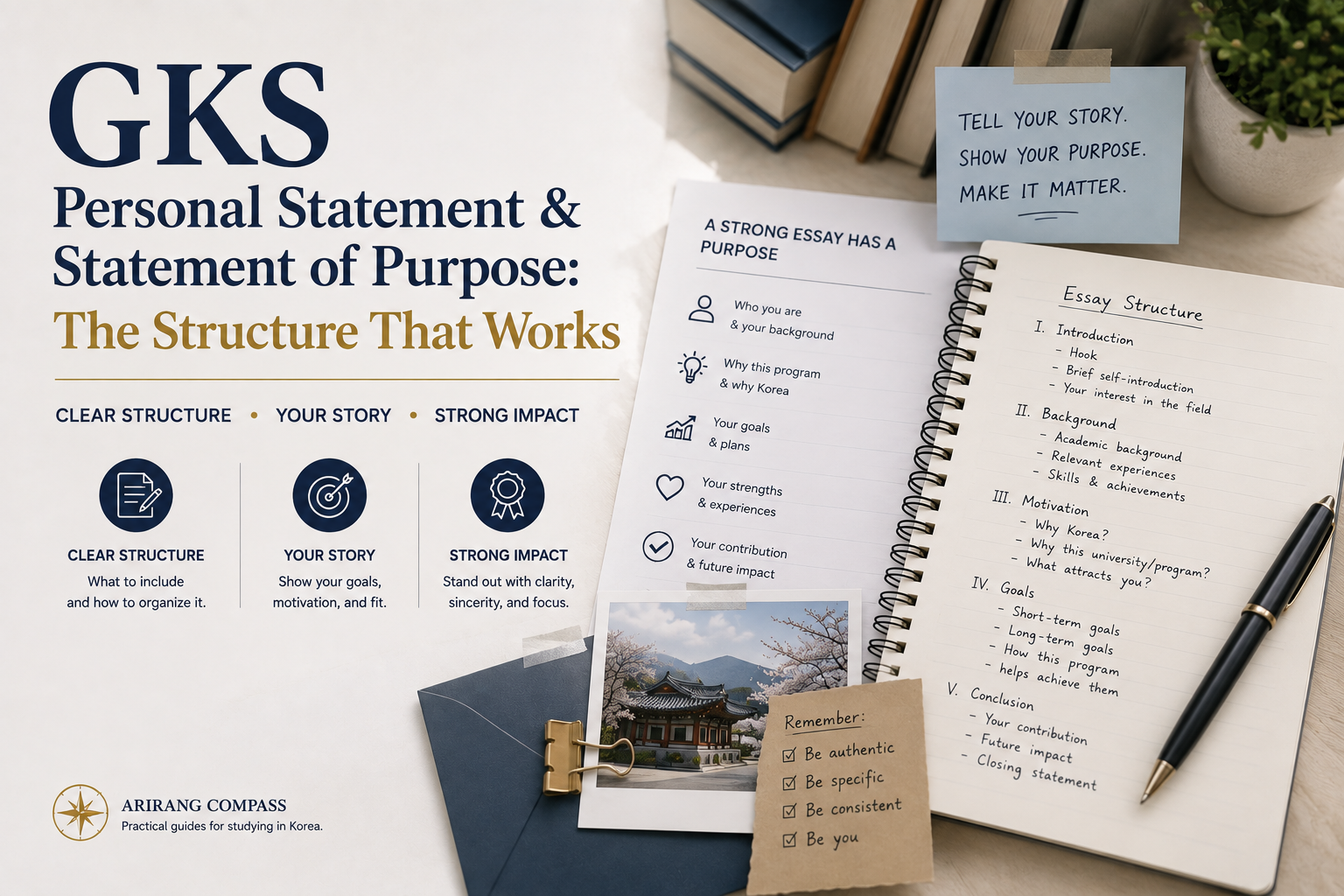
Last updated: August 2026
By the time GKS narrows its pool, almost everyone left has cleared the eligibility floor — the GPA, the language basics, the paperwork. What separates a scholar from a rejection at that point is rarely another line on the CV. It comes down to two documents most applicants underestimate — and, revealingly, mislabel.
Here is what the sample-essay blogs blur: GKS asks for two separate forms, and they are not both “personal statements.” Form 2 is the Personal Statement. Form 3 is the Statement of Purpose — and Form 3 carries three labeled sub-prompts of its own that most applicants answer as if they were one question. Collapsing the two forms into a single essay, and collapsing Form 3’s three prompts into one, are the two most common ways qualified applicants fail. This guide is about the division of labor the forms are actually asking for.
One caveat first, in the spirit of the GKS guide: form numbers, exact prompt wording, and length limits shift between cycles, and the current Application Guidelines PDF on studyinkorea.go.kr is the only version that binds you. Everything below is about structure and strategy, which stay constant. Check the current forms for the specifics.
The Two Forms, and What Each One Is For
The fastest way to write both badly is to think of them as “the essay” and “the other essay.” They have distinct jobs, and the reviewer reads them as a pair:
| Form 2 — Personal Statement | Form 3 — Statement of Purpose | |
|---|---|---|
| Tense | Mostly past and present | Almost entirely future |
| Answers | Who are you, and why does this path make sense given where you’ve been? | What exactly will you do — before, during, and after — and where does it lead? |
| Core content | Background, motivation, the story that led here, why Korea specifically | Language plan, goal of study + detailed plan, future plan after study |
| Failure mode | Generic “I have always loved Korea” | Vague “I will study hard and grow” |
Read that table twice. The Personal Statement is your past explaining your present; the Statement of Purpose is your present committing to a future. When applicants repeat themselves across the two — the same motivation paragraph, the same career line — it is because they never internalized this split. Reviewers notice immediately, and it reads as either padding or confusion. Neither wins a fully funded scholarship.
Form 2 — The Personal Statement: Structure That Works
The Personal Statement is not an autobiography, even though the prompt invites your life story. It is a targeted argument that you and this program are a coherent match. A structure that consistently works:
Open with the specific, not the sweeping. Skip “Since childhood, Korea has fascinated me” — and skip the famous-person epigraph while you’re at it. Open on the concrete moment, problem, or question that actually points at what you want to study. Reviewers read hundreds of these; the grand opener is the one they can finish for you.
Build the through-line. Your academic and personal history should read as a path toward this program, not a résumé in prose. Every experience you include should answer “and that is why this field, in Korea, now.” Cut anything that doesn’t.
Make Korea specific. “I want to experience Korean culture” is not a reason; it’s a gap where a reason should be. Why Korea for this field — a research strength, a particular scholar or lab, an industry, a methodological tradition, a policy context? Specificity here is the difference between a tourist and an applicant.
Close on trajectory, briefly. A short bridge toward what you want to become sets up the Statement of Purpose without stealing its job.
Keep it disciplined — GKS gives you roughly a page, and reviewers reward candidates who can be specific within a limit. Sprawl reads as a thinking problem, not a space problem.
Form 3 — The Statement of Purpose: Three Prompts, Three Jobs
This is where applications are won, and it is not one question. GKS breaks Form 3 into three labeled sections, and each wants something genuinely different. The trap is pouring everything into the middle one and treating the other two as afterthoughts — all three are scored.
1. Language Study Plan. The official prompt asks for your plans to improve the foreign languages — Korean, English, and others — required for your degree, before and after you come to Korea. Three things applicants miss here. First, it says before: mention what you’re doing now, not just what you’ll do on arrival. Second, it isn’t only about Korean — if your program needs English or another research language, address it. Third, this is where the funded language-training year belongs: give a current level, a target TOPIK level, and concrete plans for the year. Nearly every scholar does a year of full-time Korean before the degree, with a real TOPIK threshold to clear before advancing — showing you know this is coming signals you read the program honestly.
2. Goal of Study & Study Plan. The prompt asks for your goal of study and a detailed plan — this is the research core. You don’t need a finished thesis, but you must think like someone who will write one: a clear question, why it matters, roughly how you’d approach it, and how it connects to the specific department you’re applying to. Naming faculty whose work genuinely overlaps yours is powerful, and it’s the natural payoff of having contacted a professor before applying (guide coming soon). For graduate applicants, this section is close kin to the full research proposal (연구계획서) (coming soon) your department will later demand — treat it as the first draft of your academic identity.
3. Future Plan after Study. The prompt asks for your plan — in Korea or another country — after the degree. This is where post-scholarship contribution lives. GKS is an instrument of Korean soft power and development cooperation, and this section is where you acknowledge that without pandering. What will you do with the degree, and how does it create value — for your home country, for Korea-related work, for the field? Vague gratitude fails; a specific, plausible plan — even a modest one — is what “future plan” means here.
A useful frame: the Personal Statement earns their attention; the Statement of Purpose earns their money. Budget your effort accordingly.
The Failures That Sink Strong Applicants
Sorted roughly by how often they appear:
- Collapsing the two forms. The number-one failure. If your Personal Statement and Statement of Purpose share paragraphs, you’ve written one document twice and wasted half your allotted space.
- Answering Form 3 as one question. Pouring everything into “goal of study” and leaving the language plan and future plan thin. All three prompts are scored; treat them that way.
- Generic affection for Korea. K-content, kimchi, and “the beautiful culture” are not motivations. They are what everyone writes. If your reasons would survive find-and-replacing “Korea” with another country, they aren’t reasons yet.
- A study plan with no plan. “I will work hard, attend all classes, and become an expert” says nothing. Specifics — a research question, a TOPIK target, a timeline — are the entire point.
- Ignoring the “before” and “other languages” in the language prompt. The prompt is broader than “I’ll study Korean when I arrive.” Answer all of what it asks.
- Over-length and sprawl. Blowing past the limit doesn’t read as enthusiasm; it reads as an inability to prioritize. Concision is itself part of what’s assessed.
- Unspecific fit. Not naming the department’s actual strengths, faculty, or resources. If the reader can’t tell you researched this program, the fit argument collapses.
What Reviewers Are Actually Screening For
Strip away the advice and the rubric comes down to a handful of questions the reader is holding in their head: Is this person’s motivation specific and traceable to their history? Do the field, the program, and Korea form a coherent fit? Is the plan realistic and detailed rather than aspirational? Do they understand — and engage with — the language year and life in Korea? And will they contribute something after the funding ends?
Every strong application answers all five without being asked. Every weak one leaves the reader guessing at two or three. You don’t need to be the most decorated applicant in the pool — most winners aren’t. You need to be the one whose two forms leave nothing for the reviewer to fill in.
For where this scholarship sits in the wider funding picture, see what studying in Korea really costs and the full GKS guide. For the graduate-specific version of the fit argument, the graduate school guide (coming soon) goes deeper.
FAQ
What’s the difference between the personal statement and the statement of purpose? They’re two separate GKS forms. Form 2 (Personal Statement) is about who you are and why this path — past and present. Form 3 (Statement of Purpose) is about what you’ll do before, during, and after your degree — the future. Assuming they’re the same document, or repeating content across them, is the most common mistake.
What exactly does Form 3 ask for? Three labeled parts: a Language Study Plan (improving Korean, English, and other needed languages, before and after arrival), a Goal of Study and detailed study plan, and a Future Plan after study (in Korea or elsewhere). Answer all three distinctly.
How long should each one be? Roughly a page each in recent cycles, but the exact limit is set in the current Application Guidelines and enforced. Write to the limit, not past it — concision is part of what’s assessed.
Should I name a specific professor? For graduate applicants, yes, when the overlap is genuine — it’s the strongest evidence of real fit, and it belongs in the “goal of study” section. Empty name-dropping is transparent, so only do it if you can say why their work matters to yours. Ideally you’ve already made contact.
Do I have to write about the language-training year? Yes — the Language Study Plan prompt effectively requires it. Nearly all GKS scholars do a funded year of Korean before the degree, and reviewers look for concrete goals. Omitting it is a common, avoidable weakness.
Written from inside a Korean graduate school, where the study plan you submit is the first draft of the research identity your department will hold you to. GKS forms change every cycle — if the current guidelines contradict something here, the guidelines win, and I’d like to know so this stays accurate.
Leave a Reply