Last updated: October 2026
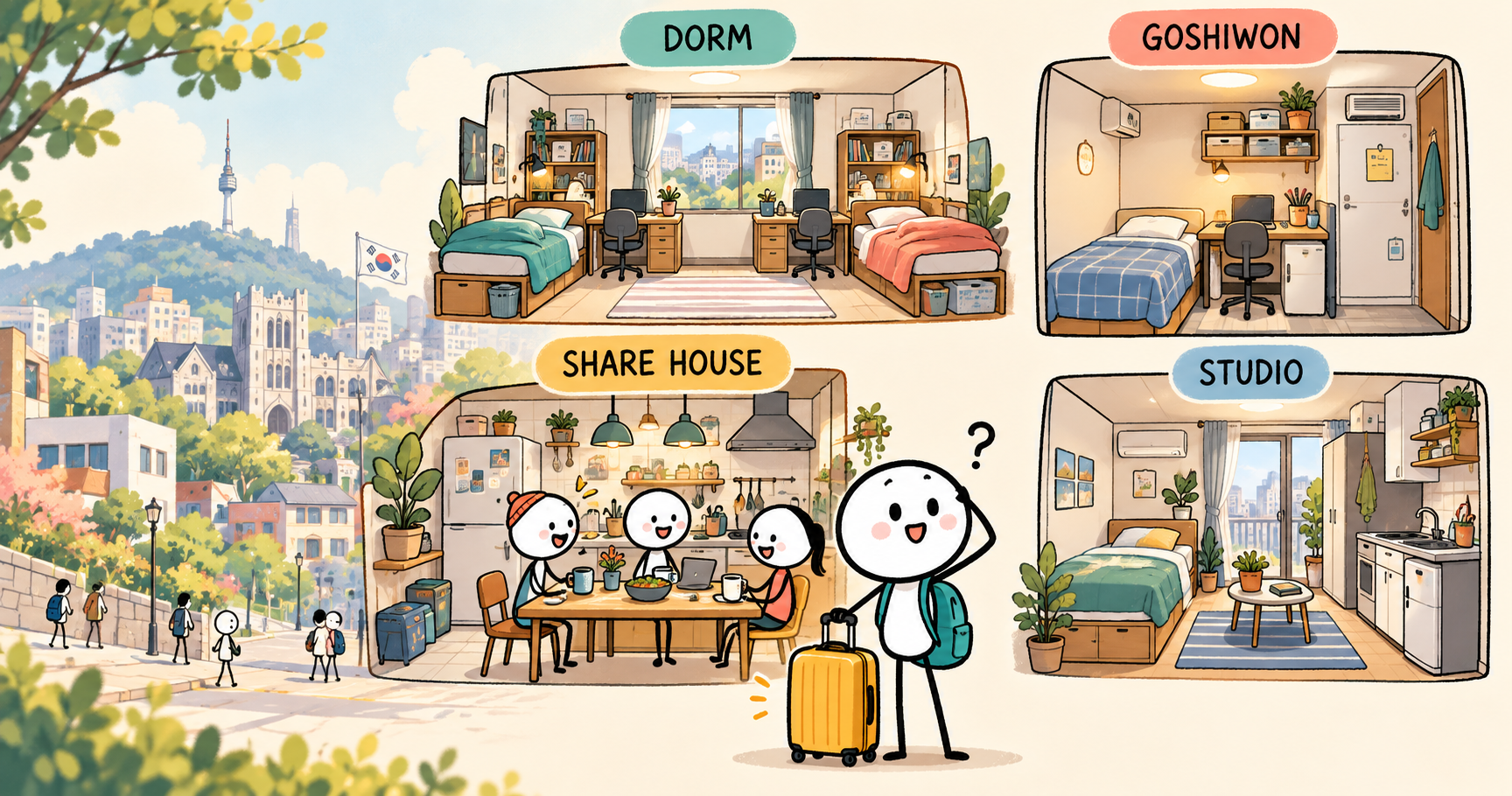
Korean student housing comes in four main types, and they aren’t four price points on one scale. They’re four different systems: different contracts, different upfront money, different rules about who you live with and how you leave. A goshiwon and a one-room can cost about the same each month and still be completely different commitments.
This guide compares the four types the way new international students actually have to decide between them: what you pay before you move in, what comes back to you, what you pay each month, what you’re signing, and how you get out. If you’re still at the “what do I do in my first weeks” stage, start with Your First 30 Days in Korea. This post picks up from the housing check-in.
The short answer
- First semester, especially your first time in Korea: a university dormitory is worth serious consideration, if the cost, meals, location, and rules suit you.
- No dormitory place, and you need somewhere soon: a goshiwon, or a share house that genuinely offers short stays. Check the minimum stay and the refund rules either way.
- You want your own space for the longer term and can manage a deposit: a one-room.
- Whatever you choose: don’t send a large deposit for a place you haven’t seen through a channel you can’t verify.
The four options at a glance
| Dormitory (기숙사) | Goshiwon (고시원) | Share house (셰어하우스) | One-room (원룸) | |
|---|---|---|---|---|
| Refundable deposit | sometimes a facility deposit | often none or small | often 1–2 months’ rent | commonly several million won |
| Paid before move-in | semester fee, often with meals | first month’s fee | first month + deposit | deposit + first month + agent fee |
| Monthly cost (Seoul) | varies widely by university and hall | ~₩390,000 average (goshiwon/원룸텔) | ~₩400,000s average | ~₩625,000 rent + ~₩84,000 management fee |
| Minimum stay / exit | a semester; refund rules for early exit | month to month, but check the refund policy | often 3–6 months | set by contract (see below) |
| Private bathroom | depends on the hall | some rooms | some rooms | yes |
| Kitchen | shared or none | shared, basic | shared | your own, small |
How to read the costs: the goshiwon and share-house figures are Seoul listing averages from Gobang (February 2025). The one-room figure comes from Dabang listings around ten major Seoul universities in July 2026, for units of 33㎡ or less on a ₩10 million deposit. The surveys use different dates and samples, so this isn’t a like-for-like comparison. What’s included also differs (utilities, internet, meals), so don’t judge total cost by the rent alone. Outside Seoul, prices depend on the region, the university, and the building; dormitories in particular aren’t automatically cheaper elsewhere.
Dormitory (기숙사)
What it is. University-run or university-affiliated halls, usually two to a room, sometimes with single or four-person rooms. Some universities have a separate international house.
Money. You usually pay per semester, in advance, through the university. Fees vary a great deal between universities and between halls on the same campus. Halls built and run through private financing (민자 기숙사) often cost more than the university’s own (직영) halls. Some halls require a meal plan, and some charge a refundable facility deposit.
Why it suits many first semesters. You usually don’t have to deal with a private landlord or a large deposit. A dormitory confirmation is accepted as proof of address for your ARC application, and you live close to class among other new students.
What to check.
- Places are limited. International students are often prioritised in their first year, but not guaranteed. Apply on the university’s schedule, which may be well before you arrive.
- Refunds: what happens if you cancel before moving in, or leave mid-semester, and how and when the facility deposit (if any) comes back.
- Vacations: whether you can stay between semesters, and at what extra cost. Find out before you book a flight home, or before you plan not to go home.
- Rules: entry hours, guests, cooking, and banned appliances.
- Documents the dormitory needs before move-in. Some require a health or tuberculosis check.
- Roommates are assigned. Ask how room changes work.
Goshiwon (고시원)
What it is. A building of small private rooms, originally for people studying for state exams (고시). You usually get a bed, a desk, and a small closet, with shared kitchen and laundry and often shared bathrooms. Places advertised as 원룸텔 or 고시텔 often have private bathrooms, but the name alone doesn’t guarantee the room size, a bathroom, or the level of service. Check each room.
Money. There’s usually no deposit or only a small one, you pay monthly, utilities and internet are often included, and you can often move in quickly. Seoul listings for goshiwon and 원룸텔 averaged about ₩390,000 a month in 2025 data. Rooms with a private bathroom or an outside window cost more, and short-term rooms near popular campuses at semester start can cost much more. Paying monthly doesn’t automatically mean flexible refunds. Ask about the minimum stay and what you get back if you leave mid-month.
What to check.
- Size and windows. Seoul’s building ordinance, in force since July 2022, requires goshiwon rooms to have at least 7㎡ of private floor space (9㎡ including a private bathroom) and a window opening to the outside large enough to escape through. It applies to new construction and expansions, and also to repairs, changes of use, and other building work that needs a permit. It doesn’t automatically apply to every existing building, so many older rooms are smaller. The rule is Seoul’s; other cities differ. When a listing says “window,” ask whether it opens to the outside or only onto the corridor.
- Fire safety. Ask to see the sprinklers, the emergency exits, and the escape route from your floor. Goshiwon fires have killed residents, and fire safety was the reason for the new rules.
- Noise. The walls are often thin.
- Proof of address for your ARC. Ask the manager in advance whether they’ll provide what immigration needs, typically a residence provision letter (숙소제공확인서) with their details. Confirm before you pay.
Who it suits. Students without a dormitory place, waiting for one, or bridging the weeks before a longer lease starts. Some students stay longer on a tight budget, which is a legitimate choice. See the actual room first, because listing photos can be generous.
Share house (셰어하우스)
What it is. An apartment or house split between several tenants, each with a private or shared bedroom and with a shared kitchen, living room, and often bathroom. Some are run by companies with many houses; others by individual landlords. “Co-living” buildings vary just as much, so judge the building rather than the label.
Money. A deposit, often one or two months’ rent, plus monthly rent. Seoul listings averaged in the ₩400,000s in 2025 data. Utilities may be included or split, so ask which.
Short stays: only where they’re actually offered. Many share houses have a minimum stay of three to six months. If you need somewhere for a few weeks, look for operators that explicitly offer short contracts, and get the minimum stay and the early-exit terms in writing.
What to check.
- The agreement. A short contract can be perfectly adequate. What matters is that it clearly states who the parties are, the address and room number, the deposit, any extra charges, the notice period, and how and when the deposit is returned, including any cleaning deductions.
- Housemates. Ask how many people share a bathroom, and visit when others are home.
- Proof of address for your ARC: confirm, as with a goshiwon.
One-room (원룸)
What it is. A small self-contained studio with its own bathroom and a compact kitchen. It’s one of the most common choices for Korean students living off campus. Many come with some furniture and appliances (the “옵션”), but don’t assume a bed is included. Ask for the list. An officetel (오피스텔) is a similar unit in a mixed-use building.
Money. You pay a refundable deposit (보증금), usually several million won and often ₩10 million in Seoul, plus monthly rent (월세) and a management fee (관리비), and usually a commission (중개수수료) to the agent. In the July 2026 Dabang data above, the average around ten major Seoul universities was about ₩625,000 rent plus ₩84,000 management fee. A larger deposit usually brings a lower rent, and vice versa.
Who it suits. People who want their own bathroom, kitchen, and routine, plan to stay a while, and can manage the deposit. Noise and guest rules still depend on the building and the contract.
Contract length and leaving early
Listings often advertise one-year terms, but the term in your contract and the protection the law gives you aren’t the same thing. Under Korea’s Housing Lease Protection Act, a residential lease shorter than two years is, in principle, treated as two years. That protects the tenant, and the tenant can still choose to rely on the shorter agreed term. So a one-year contract doesn’t mean the landlord can make you leave after a year, and it doesn’t force you to stay two. Whether a particular arrangement counts as a residential lease under the Act is worth asking about if you’re unsure.
Leaving before the end is a separate matter. Finding a replacement tenant doesn’t by itself end your contract. Get the landlord’s agreement, the end date, who pays the remaining rent and the agent’s fee, and when your deposit comes back, all in writing.
Protecting your deposit: three separate things
These get mixed up, and they aren’t the same:
- Change-of-address report to immigration. Once registered, you must report a move within 15 days. For a foreign resident, this report has the same legal effect as a Korean’s resident registration move (전입신고). Combined with actually moving in, that gives you opposability (대항력), the right to assert your lease against a new owner. That protection takes effect from the day after both conditions are met, not from your deadline. Report promptly; the 15 days is a deadline, not a waiting period.
- A fixed date (확정일자) on your lease. This adds priority repayment, your place in the queue to be repaid if the property is auctioned. You can get it at a community service center or online.
- Housing lease report (임대차 신고). In covered areas, which include the Seoul metropolitan area and other major cities, leases with a deposit over ₩60 million or monthly rent over ₩300,000 must be reported within 30 days of signing. Many student one-rooms in Seoul cross the rent threshold. Filing the report also gives your lease a fixed date. Ask your agent who files it.
Before signing, check the property registry (등기부등본) for debts secured against the building, and confirm that the person signing is the registered owner or holds written authority from them. The details of deposits, registry checks, and what to do if a deposit isn’t returned will be in How Korean Housing Deposits Work (coming soon).
Paying the deposit
- Know who you’re paying. An account number written in the contract doesn’t, on its own, prove that person’s authority. The account holder should be the owner or someone with documented authority to receive the money.
- Check your bank’s transfer limits. If your Korean account is still transaction-limited (한도제한계좌), a multi-million-won transfer may exceed the daily limit. Talk to your branch well before the payment date: How to Open a Bank Account in Korea.
- Language. Contracts and agents mostly operate in Korean. Bring a Korean-speaking friend, or ask your international office whether it works with agents used to helping students.
How to choose
Your first semester. If a dormitory place fits your budget, meals, location, and the way you live, it’s usually the simplest start, and you’ll make a better off-campus decision once you know the city. Don’t sign a long lease from abroad based on photos.
No dormitory place. Book a goshiwon, or a share house that offers short stays, for the weeks you need. Choose one you or someone you trust has seen, and look at longer-term options in person once you’ve arrived.
Count the upfront money as well as the monthly figure. A one-room’s deposit can be larger than a year of goshiwon rent, even though most of it should come back. The full cost picture is in What It Really Costs to Study in Korea.
Match the location to your real week. Classes, the library, a lab or studio, a part-time job: a slightly pricier room near where you actually spend your days often beats a cheaper one forty minutes away by bus.
Re-choose when your needs change. None of these is a step on a ladder. Plenty of students move from a one-room back to a dormitory, or stay in a good goshiwon for years.
Before you pay anyone
The paperwork:
- ☐ See the room, in person or through a trusted person on a live video call, and make sure the room you see is the room you’ll get.
- ☐ Get the terms in writing: rent, deposit, what’s included, minimum stay, notice period, and when the deposit is returned and what can be deducted from it (cleaning, damage).
- ☐ Confirm who receives the money and that they have the authority to.
- ☐ Confirm proof of address for your ARC.
The room itself:
- ☐ What the management fee covers, and which bills (electricity, gas, water) are separate
- ☐ Signs of mould or leaks, ventilation, water pressure, and hot water
- ☐ How heating and cooling work, and any limits on using them
- ☐ The list of furniture and appliances provided, and who pays when something breaks
- ☐ Photos and video of the room’s condition on move-in day, your evidence when the deposit comes back
FAQ
Can I live in a goshiwon for my whole degree? Some students do. Whether it’s sustainable depends on the room: one with an outside window and a private bathroom is a different life from a windowless room on a shared floor.
Is a share house safer than a goshiwon? Not automatically. Judge the specific building, the agreement, and the operator rather than the category.
Do I need a Korean bank account to rent a one-room? It makes monthly payments much easier, since rent and management fees are usually paid by transfer. Whether you can sign without one is up to the landlord. Ask before signing which payment methods they accept and how the deposit should be sent.
What is 전세, and should I consider it? 전세 is a lump-sum deposit with no monthly rent. The deposit is very large, often a substantial share of the property’s value, and deposit-fraud cases have made it a risky place for newcomers to start. Most students rent monthly (월세).
Your first room in Korea is rarely your last one. Choose what keeps you safe and flexible while you learn the city, and choose again when your needs change. If your housing hunt taught you something this guide missed, tell me and the next version will include it.
Leave a Reply