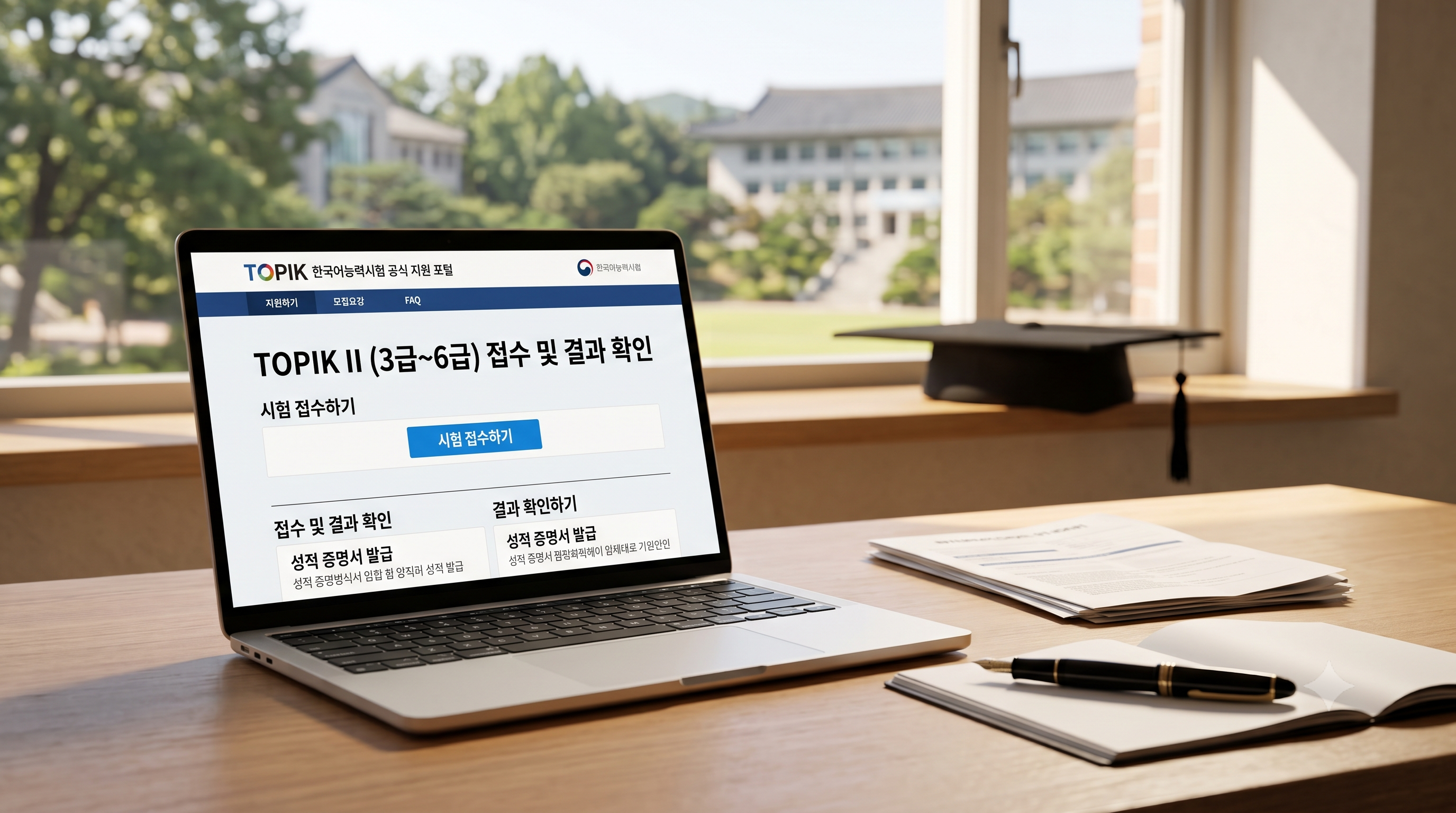
TOPIK Requirements for Korean Universities: Admission, Major Entry, and Graduation (2026–2027)
Last updated: August 2026
“Do I need TOPIK to study in Korea?” has a short answer and a more useful one. The short answer is “usually Level 3.” The more useful answer is that TOPIK isn’t one gate — it’s up to three gates at different points in your degree, and universities set the bar differently at each one. Some ask for a score before they’ll read your application. Some admit you with no score and require Level 3 before you can enter your major. Some — including universities that asked for nothing at admission — require Level 4 before graduation.
Once you see the three-gate structure, the patchwork of university policies becomes legible. This guide lays it out: what each level means in practice, how six universities handle each gate in the 2026–2027 admissions cycle, where your major moves the bar, and what your level is worth in scholarship money. It is a guide to how the requirements work, not a database of every university — the database is your target school’s 모집요강 (admissions guide), and this post will tell you what to look for in it.
TOPIK in One Minute
TOPIK (Test of Proficiency in Korean) is the state-run Korean test administered by NIIED. It comes in two papers: TOPIK I (Levels 1–2, listening and reading) and TOPIK II (Levels 3–6, adding writing). University requirements almost always refer to TOPIK II levels. Most Korean-medium degree programs that require TOPIK use Level 3 or above as their starting point, although conditional-admission routes may accept lower levels.
The descriptions below are practical approximations, not official TOPIK or CEFR equivalencies:
| Level | In a lecture hall |
|---|---|
| 3 | You can handle daily life and follow announcements; lectures are still a struggle |
| 4 | You can follow most lectures and read course materials slowly; the most common graduation bar |
| 5 | You can write reports and hold your own in group projects |
| 6 | Highly advanced proficiency; required by a small number of specific programs |
Two administrative facts cause more failed applications than any level cutoff. Scores are valid for two years from the test date — check validity against your application month, not today’s date. And sittings are limited: six a year in Korea, often only two or three overseas, with score release dates set per sitting. The official calendar, including each sitting’s release date, is at topik.go.kr.
Official minimum vs. what you actually need. Every number in this post is a published eligibility threshold. Eligibility is what gets your application read; it says nothing about whether you can follow a Korean-medium lecture. Level 3 holders routinely describe their first semester as survival. Treat the published minimum as the entry ticket and plan to be at least one level above it by the time classes start.
Gate 1: Admission — What You Need to Apply
For Korean-taught undergraduate programs, the most common published floor is TOPIK Level 3. But the floor is where the variation begins. Here is how six universities handle Gate 1 — selected examples, each checked against the admissions guide for the cycle named:
| University | Cycle checked | At application | Later requirement |
|---|---|---|---|
| Seoul National | 2026 undergraduate | TOPIK 3+ (or SNU KLI Level 4+), or English: TOEFL iBT 80 / IELTS 6.0 / TEPS 551 | Program-specific — some programs set substantially higher Korean requirements; check the program notes |
| Korea University | Fall 2026 (with Spring 2027 change noted) | No minimum level: any official TOPIK score, KU Korean Language Center completion, Sejong Institute intermediate, or TOEFL iBT / IELTS Academic. From Spring 2027, KU’s own online Korean test is no longer accepted — an official score is mandatory | Major entry gated by TOPIK level (see Gate 2) |
| Yonsei | Fall 2026 | No fixed level: any Korean or English proficiency evidence (TOPIK, TOEFL/IELTS, KLI completion, or schooling in Korean/English) | TOPIK 3 before declaring a major; TOPIK 4 before graduation |
| Ewha | Fall 2026 | Freshmen: no language requirement at application. Transfer and graduate: TOPIK 4+ or TOEFL iBT 80 / IELTS 6.0 / New TEPS 326 | TOPIK 3 (or equivalent) before major coursework; TOPIK 4 before graduation, except Division of International Studies |
| Pusan National | Spring 2026 | TOPIK 3–5 by department (e.g., TOPIK 4 or PNU LEI Level 4 for several humanities and social science departments); English substitute only for applicants from seven English-speaking countries | Conditional admission for current PNU LEI students — cancelled if the completion certificate misses the deadline |
| KAIST | 2026 undergraduate | No TOPIK. TOEFL iBT 83 / IELTS 6.5, waived if prior schooling was in English | None (English-medium) |
Sources: SNU international admissions, Korea University Fall 2026 freshman guide (KOR), Yonsei Fall 2026 application guide, Ewha international undergraduate page and Fall 2026 guide, PNU Spring 2026 guideline, KAIST admissions.
Read the table for its pattern rather than its details, because the details change every cycle. The pattern: the large private universities in Seoul increasingly accept you on almost any proof of language ability and move the real test to later gates, while the flagship regional nationals often set higher bars by department at the door, because their programs are more thoroughly Korean-medium. And the English-alternative column is narrower than it looks — at a Korean-medium university, an English score can satisfy the admission requirement while your classes remain in Korean.
Gate 2: Entering Your Major — The Checkpoint Outside Guides Miss
Several universities admit international freshmen with little or no Korean, then require a TOPIK level before they can enter major coursework. This is the gate that turns “no TOPIK required” into “TOPIK required within a year.”
Korea University is the clearest example, because it publishes the mechanism: with TOPIK 5 or higher, you are assigned your first-choice major. With TOPIK 4, you are assigned the major but may take only six credits of major courses per semester. With TOPIK 3 or below, you cannot enter the major you applied for. Admission and major entry are separate decisions, made on separate scores. (KU international curriculum guide)
Yonsei requires TOPIK 3 before declaring a major; Ewha places freshmen in a Global Scholars Program and requires Level 3 or its equivalent before major coursework. Kyungpook National University has created a liberal-studies division where international students spend their first year in Korean-language courses before selecting a major.
The practical meaning: if you enter on the no-score route, first-year Korean is your most important subject — administratively as well as academically. Students who treat it as an elective sometimes discover in their second year that they have been admitted to a university but not yet to a degree program.
Gate 3: Graduation
Some universities require a TOPIK level before conferring the degree, independent of what was required at admission. Yonsei requires TOPIK 4 before graduation, satisfiable by a test score or a designated course level at its Korean Language Institute. Ewha requires all international undergraduates to submit TOPIK 4 before graduation, exempting only its Division of International Studies. Pusan National ties continuing scholarships, though not the degree itself, to language and academic standing.
This is not a nationwide rule. Whether a graduation requirement exists — and whether it applies to you — depends on the university, the track (Korean-medium or English-medium), the admission type, and sometimes the year you entered, since requirements are typically fixed by the guide in force at admission. English-track colleges have historically been exempt, though a few universities have begun introducing modest Korean requirements for them. The only reliable source is the 모집요강 for your intake, read for the graduation section as well as the admission section.
How Your Major Moves the Bar
Within a single university, departments set their own expectations, and the pattern is consistent enough to be useful:
- Business, economics, law, media, and Korean language and literature tend to sit at the top — Level 4 or 5 at application is common, and some programs go higher. These programs run on reading, writing, and discussion.
- Humanities and social sciences commonly ask for Level 4 at the regional nationals, Level 3 at universities that defer the real test to Gate 2.
- Engineering, natural sciences, and computing are typically at the published floor, because technical content carries much of the load and English textbooks are common. These departments also have the deepest English-taught catalogs .
- Arts, music, and design vary by program — some require higher levels for theory components (Hongik, for example, sets a higher scholarship threshold for architecture and fine arts than for other majors), while practice-based admissions weigh portfolios above language.
The rule of thumb: the more your grades depend on producing Korean text, the higher the bar — and the less the published “Level 3” should reassure you.
Graduate School: A Separate Set of Rules
Graduate-school requirements are less standardized than undergraduate ones. Some departments require TOPIK 3 or 4, some accept English scores instead, and others impose department-specific conditions such as a prospective advisor’s consent form. Check the graduate school’s general guide and the department’s own guide separately — they frequently differ.
The formal requirement determines eligibility; the working language of the lab determines whether that minimum will be sufficient in practice. A lab that runs meetings and reports in Korean will expect considerably more than the catalog minimum, and the only way to know is to ask. The graduate school guide covers how that conversation works.
What Your Level Is Worth in Scholarship Money
Universities use TOPIK as a primary sorting key for entrance scholarships, and the structures are similar enough across schools to compare — but the terms are each university’s own:
| University | Level 4 | Level 5 | Level 6 |
|---|---|---|---|
| Hongik | 50% of tuition and accommodation | 60% | 70% |
| Pusan National (first semester) | Tuition I waived in full | Tuition II waived in full | Tuition I and II waived in full |
| Ewha | — | — | Full tuition scholarship for TOPIK 6 entrants (details by intake guide) |
Sources: Hongik Global Scholarship, PNU Spring 2026 guideline, Ewha international undergraduate page. “Tuition I / Tuition II” is PNU’s own division of the fee; the applicable admissions guide defines it.
Two mechanics matter more than the percentages. First, the entrance scholarship is usually decided on the score you hold at application: Ewha states that a score earned later satisfies eligibility but not scholarship consideration. A Level 5 earned before you apply can be worth a semester’s tuition; the same score earned three months after enrollment may be worth nothing. Second, renewal conditions are mostly academic, not linguistic — PNU, for instance, renews from the second semester on a previous-term GPA of 2.5 (on 4.5) and at least 12 credits completed. Some universities also pay small bonuses for improving your level after entry (Hongik does). The university scholarship guide and the TOPIK-linked scholarship map go deeper; the strategic lesson is simple: test before you apply, not after.
TOPIK and Part-Time Work
TOPIK can affect the number of hours you are permitted to work part-time on a D-2 visa, but it is only one part of the calculation. The limit also depends on your degree level, year of study, academic standing, your university’s accreditation status, and whether the work falls on a weekday, weekend, or vacation. These are immigration rules rather than university rules, so check the current table at Hi Korea or Study in Korea before planning around them — and note that permission must be obtained before you begin working. The part-time work rules guide covers the current details.
If You Don’t Have the Score Yet
Three routes, covered in full in the complete application guide:
- Conditional admission through the university’s own language institute. PNU, for instance, admits students currently enrolled at its Language Education Institute on condition that they submit the completion certificate by a fixed date; if it is missed, the admission is cancelled. Many large universities run some version of this.
- The language-institute pathway — two to four semesters on a D-4 visa at a Korean Language Institute, then apply with a score. Slower, but it solves the language and the “never lived in Korea” problem at once. The D-4 to D-2 change is routine once the score is in hand.
- English-taught programs, where TOEFL or IELTS replaces TOPIK — narrower in majors, pricier at the private international colleges, and not always free of Korean requirements at later gates.
What doesn’t work: assuming that a university which asked for nothing at admission has no language requirement at all. Check Gates 2 and 3 before relying on that.
Building a Timeline Around the Test
Because sittings are fixed and results take weeks, the test often drives the calendar more than the application deadline does. For a March start — applications in September to November — a spring or early-summer sitting is the safe source of your score, which means preparation starts the previous winter. For September admission, an autumn test in the previous year gives overseas applicants the widest safety margin, although an early test in the admission year may still produce results before some universities’ deadlines — check the score release date against each deadline rather than assuming. The March vs September intake guide walks the full backward calendar.
FAQ
Is TOPIK 3 enough to study in Korean? Enough to be admitted at many universities, yes. Enough to follow lectures comfortably, usually not. Treat Level 3 as the entry ticket and Level 4 as the point where the degree becomes manageable.
Can I submit TOPIK I (Level 1–2)? Not for regular degree admission at universities with Korean-track programs. Lower levels sometimes appear in conditional-admission policies, always paired with a requirement to reach a higher level later.
My score expires before the application window. What now? You need a fresh sitting; there is no extension. Register for the earliest available date — domestic sittings fill in application season, and overseas sittings are scarce.
Do graduate programs need Level 4? Often as a published floor, but it varies by department, and some accept English scores instead. Read the graduate school’s guide and the department’s guide separately, and ask your prospective advisor how the lab actually operates.
Does TOPIK affect my visa? Not directly for issuance — the D-2 is tied to your admission — but it is one of the factors in part-time work permission once you are here, and an official, valid TOPIK score report is the simplest evidence of language preparation at every stage of the process.
Written from inside a Korean national university — one of the ones that sets its bar by department. Requirements are taken from each university’s published admissions guides for the cycles named; they change every cycle, and the 모집요강 for your intake overrides anything written here. This post is updated when new guides appear each spring and autumn.
Learning Korean before you arrive? I also write A Linguist Looks at Korean — a free weekly newsletter on why Korean works the way it does: particles, politeness, and the things textbooks rush past. → Subscribe on LinkedIn
Leave a Reply